-
bluesign
Quality and safety are the key factors that have been driving us further since the very beginning. When making responsible and innovative high-performance ropes we also consequently have been following the maxim of sustainability. This is why EDELRID has set new industry benchmarks for sustainable rope production.
We are the first rope manufacturer to adapt our ropes to meet the tough demands of the Swiss bluesign System. It is the most stringent environmental standard for the production of textile products: independent, internationally recognised and based on the five principles of resource productivity, consumer safety, water emission, air emission as well as occupational health & safety.Our ropes carry the bluesign PRODUCT label thanks to their combination of certified source materials and our advanced rope production facilities in Isny.
The bluesign PRODUCT label is a seal of quality: It guarantees an eco-friendly manufactured product that is low in pollutants and safe for health and the environment. As such, we have responded to the natural demands of our customers for safe, environmentally friendly and sustainable products.
Eight years of working together with bluesign technologies ag in Switzerland, allow us to draw on in-depth experience of sustainable rope production. By converting all our rope production to the tough demands of the bluesign System we were able to make the following efficiencies when dyeing sheath yarns:
62 %CO2 reduction89 %savings in water63 %less energy consumption63 %less chemicals -
Upcycled
Upcycling involves reusing existing materials or production remnants and converting them into a new product or component without fully returning them to their original raw material state. The further processing involved may also require energy and additional materials.
-
Recycled
This product contains components made from recycled raw materials. The respective recycled content, as well as the material or component concerned, is specified on a product-specific basis.
-
Climb Green

“Climb Green” is a label developed internally by EDELRID that was originally introduced to make more responsibly produced alternatives visible and to help end consumers identify, within a product category, the product that EDELRID considers to be the more responsible choice. As “Climb Green” is a proprietary company label rather than an independent sustainability certification, it will no longer be used for product labelling in the affected markets from 27 September 2026 onwards, following the entry into force of the new EmpCo requirements.
-
NFC inside
Products with integrated NFC transponders for quick registration and effective management of PPE. Using compatible software, application cycles and/or the PPE status of the product can be monitored. Digital management enables faster access to relevant product information and improves traceability.
-
Indicator webbing
Webbing with internal wear indicator made of red polyester fibers. In the event of excessive wear a red wear indicator warning thread becomes visible – alerting the user that the product should be replaced.
-
Failsafe 180°
Bypass-save shock absorber (180° incorrect use): When using conventional Y-shape lanyards, there is a risk of the lanyard’s shock absorber being ‘short-circuited’ if the second lanyard arm isattached to a load-bearing section of the full body harness (e.g. a position eyelet). After a short braking distance, the connector becomes static, resulting in a significantly higher risk of extremely serious injuries. In the worst case scenario, the high forces applied to the seam between the two arms as a result of the 180° incorrect use can cause the lanyard to tear at this point. This would result in a complete fall. Thanks to an innovative design, the shock absorbers on the most EDELRID lanyards with two arms are fully functional even in the event of 180° incorrect use. The patented design also works without restriction if the load-bearing arms are ‘short-circuited’. This means that the second lanyard arm can be attached to the load-bearing elements on the full body harness. All EDELRID products that are 180° fail-safe are labelled with this symbol.


Ropes
-
Single rope
Single ropes are the most common type of climbing rope. They are the classic climbing rope, as it were. Single ropes come in different lengths and diameters and cover a range of different applications. They are classic sport climbing ropes, for both outdoor and indoor use, and are also used for alpine climbing and mountaineering and by big wall climbers. One of their main advantages is their simple and uncomplicated handling. EDELRID manufactures single ropes in diameters from 8.9 mm to 10.5 mm. They weigh in at 52 to 69 grams per metre. Single ropes with a thicker diameter are generally stronger and can withstand a greater number of falls. However thicker also means heavier. For intensive use, such as working routes or top-roping, there are robust single ropes with a higher sheath proportion.
-
Twin rope
Twin ropes must always be used in pairs. They only offer standardised safety when used as a pair. It is important that twin ropes are always clipped together into each bolt or piece of protection. They have a lighter weight and a thinner diameter. Twin ropes offer greater safety reserves due to increased redundancy that comes with using two ropes. Twin-rope techniques also provides increased safety due to their significantly greater sharp edge resistance as well as reducing the risk of a total failure (stonefall, breaking over a sharp edge). This is why twin ropes are particularly suited to alpine climbing in demanding terrain or for ice and mixed climbing. Using twin ropes also allows you to abseil twice as far, which means that you can escape from a wall quicker. Twin ropes normally have a diameter of 6.9 to 8 mm and weigh around 40 grams per metre.
-
Half rope
Half ropes (also known as double ropes) are designed, like twin ropes, to be used as a pair. The same as twin ropes they also only offer standardised safety when used as a pair. However, unlike twin ropes, half ropes do not need to be clipped together into each bolt or piece of protection. This technique is ideal for poorly protected or zig-zagging routes or for traditional climbing (trad). It allows rope drag to be reduced where protection points are spread out and considerably reduces impact force. It follows that climbing with a pair of half ropes requires using a belay device that allows you to manage two ropes simultaneously, i.e. to be able to pay out and take in both ropes. Half ropes are used for the same activities as twin ropes. They have one important difference – half ropes can be used as a single rope to bring up a second. This is particularly relevant when climbing as a party of three and bringing up two seconds. Half ropes range in diameter from 7.5 to 9 mm and generally weigh from 40 to 50 grams per metre.
-
Eco Dry
 Per- and polyfluorinated chemicals (PFCs), and especially the PFAS group of substances, are used in outdoor equipment to provide water-, oil-, and dirt-repellent properties. As these substances degrade only very slowly in the environment, they are considered particularly persistent.With Eco Dry technology, a treatment process has been developed that does not use PFCs or PFAS while supporting the performance requirements of climbing ropes. Since 2026, all corresponding EDELRID ropes have been treated with Eco Dry technology.Due to their three-dimensional kernmantle construction, ropes place specific demands on the finishing process. In addition to providing water-repellent properties, the safety-relevant characteristics and functionality of the rope must be maintained. The Eco Dry process meets these requirements without the use of PFCs or PFAS.Compared to untreated ropes, ropes treated with Eco Dry show measurably lower water absorption compared to ropes without Eco Dry treatment.
 -
Color Tec
An innovative braiding process for making bicolor ropes. The woven design of the rope completely changes when it reaches the middle. This provides a permanent and distinctive middle marking. We use this technique exclusively for ropes in our Pro Line. During braiding, the bobbin order of the sheath yarns alters on the braiding machine automatically at the middle of the rope. The design then changes so that two rope halves of the rope are easy to distinguish. The ColorTec braiding process makes both color and design changes possible.
COLOR TEC BENEFITS AT A GLANCE
BRAIDING TECHNIQUE FOR BICOLOR ROPES
- both color and design changes possible
- unmistakable design
- two distinct rope halves ensure permanent middle marking
- two braiding circles
-
Cut Protect

GIVE SHARP EDGES THE COLD SHOULDER
The development of a new braiding process and the combination of high-strength aramid and polyamide fibers allow us to produce ropes with a high cut resistance.
While problems such as acid contact and friction burns can be excluded as far as possible through proper application and storage, edge loads are still a problem.. The edge does not even have to be particularly sharp.
It becomes particularly problematic when there is a pendulum movement over an edge (e.g. when abseiling or lowering). Then, in addition to the edge load, a cutting load occurs, which can have fatal consequences. The rope is cut through, so to speak. How can we mitigate these risks?
At EDELRID we have tackled the problem and developed a rope that has a particularly high cut resistance. This is made possible by the new "Cut Protect" rope technology. This means high-strength aramid fibers are braided into the rope sheath during the braiding process. Compared to polyamide, aramid has a significantly higher cut resistance.
THE CRUX:
aramid is a particularly static material. Compared to polyamide, it has virtually no dynamic properties. However, in the event of a fall, it is necessary to absorb the resulting energy and thus reduce the impact force to a tolerable level.
Since the current standard for dynamic mountain ropes does not include a test procedure for assessing the cut resistance, at EDELRID we have developed a special machine that simulates this load under laboratory conditions. The internal comparison of the Swift Pro Dry and the Swift Protect Pro Dry shows that ropes with Cut Protect technology have
almost twice as much cut resistance as conventional mountain ropes.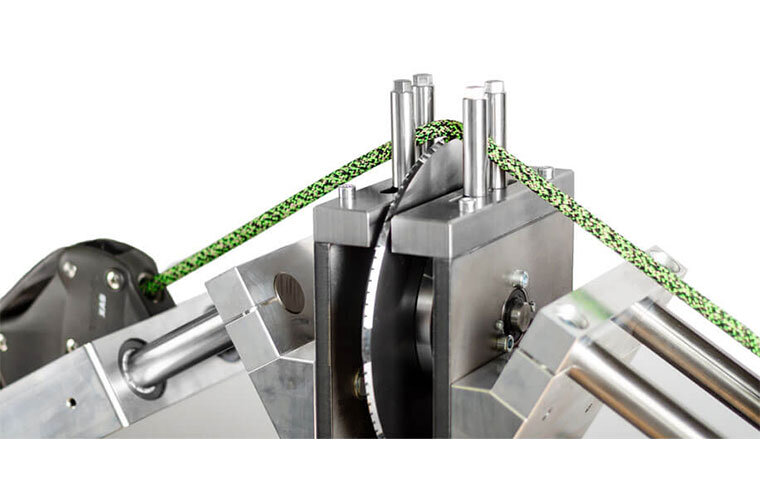
-
Duo Tec
A patented braiding process developed by EDELRID for the production of bicolor ropes. The two halves of the rope are clearly distinguishable due to a change in pattern halfway along the rope. The middle of the rope can always be clearly identified, which is a great advantage especially when abseiling, coiling a rope, or estimating how much rope you have left. This change in design is achieved by a bicolor strip woven into the sheath. On reaching the middle of the rope, the strip automatically switches from one side (e.g. green) to the other (e.g. black). This gives the rope a permanent center mark.
DUO TEC ADVANTAGES AT A GLANCE
BRAIDING METHOD FOR BICOLOUR ROPES
-
only change of design possible
-
braided tape (two colours)
-
permanent centre detection
-
-
Thermo Shield
Thermo Shield is the basic treatment applied to all our ropes to support the well-known handling characteristics of EDELRID ropes. This treatment is a thermal process in which core and sheath yarns are harmonised with one another. Through a specialised heat treatment, the fibres within the rope are stabilised and the interaction of the yarns inside the rope is optimised. It reduces the tendency of the rope to shrink and become stiff over time.
THERMO SHIELD ADVANTAGES AT A GLANCE
THERMAL REFINEMENT
- Suppleness
- compactness
- longer service life
- reduced tendency to shrink
-
Lap Coil
The 3D lap coiling technique makes uncoiling the rope for the first time unnecessary. We extended our production site with a specially developed lap coiling machine that winds up our ropes. In combination with the thoughtout design of the packaging provided with every EDELRID rope, it has now become super easy to instantly start your climb using your new rope: You do not have to do more than pulling it out! The marking on the rope as well as a detailed description on the packaging additionally ensure that you do things right and can use the full potential of the rope without annoying twisting and tangling.
-
Link Tec
This procedure bonds together the core and sheath during the braiding process to minimize sheath slippage and significantly increase the rope’s service life. We have always used this technology for our climbing gym ropes, which have to withstand the intensive, prolonged loads of top-roping.
-
Sync Tec
Unlike conventional kernmantle ropes, ropes featuring SyncTec technology incorporate a mechanical connection between the core and sheath. During the manufacturing process, the core and sheath are interwoven at regular intervals. As a result, they are not subject to the potential degradation of chemical bonding methods, such as adhesive bonding, that may be used in other rope constructions. By connecting the core and sheath, both rope components form an integrated structure. This supports load transfer between the rope components and influences the rope's construction characteristics. The resulting design provides a compact rope structure and defined handling characteristics. In addition, the connection between the core and sheath remains in place even if the sheath is damaged, for example by a sharp edge. This can help maintain the connection between the core and sheath under such conditions. SyncTec ropes are suitable for applications in work at height, rescue operations and other areas where the characteristics of a permanently mechanical core-to-sheath connection are required.


Terminations
-
Sply
The splice has a long tradition as a compact and streamlined rope termination. The patented SPLY is designed so that the rope diameter increases only slightly, including in the splice eye. This design allows compatibility with commonly used SRT and DRT devices and can reduce the need to pull the rope completely through the system during installation. In addition, part of the core extends through the entire splice eye as part of the splice construction. The SPLY is manufactured by hand in Isny.
-
Sewn termination
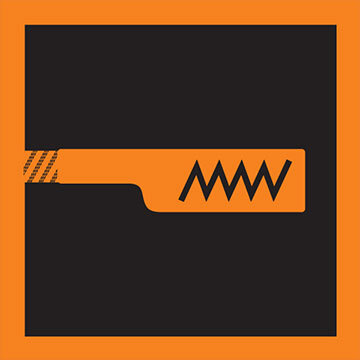
The sewn termination is used wherever a compact and load-bearing rope termination is required. The rope end is folded back and sewn to form a termination eye. A transparent protective sleeve helps protect the stitching from damage while allowing visual inspection of the seam. The characteristics of the sewn termination depend on the construction and diameter of the respective rope. Detailed information can be found with the individual rope specifications.
-
Weblink
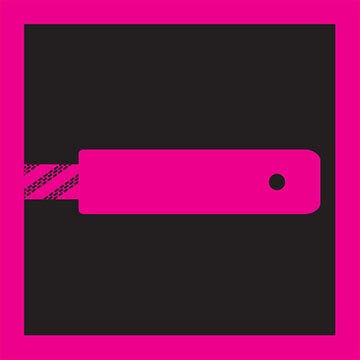
The Weblink is the slimmest rope termination within the range. This can be advantageous when the rope needs to be passed through small openings, such as the rings of a cambium saver. The termination is created by sewing a narrow polyester or Dyneema® webbing to the end of the rope. An abrasion protector helps protect the termination from mechanical wear. Depending on the application, EDELRID offers three variants of this termination. All Weblink terminations provide a strength of > 15 kN. The Weblink features an abrasion protector with an integrated inspection window for installation checks. When the carabiner is installed correctly, the sewn polyamide webbing is visible through the inspection window. If installed incorrectly, the carabiner can be seen instead. The abrasion protector also helps keep the connector in position and supports its alignment within the system. For visual inspection, the abrasion protector can be removed completely. The Weblink Indicator incorporates all features of the Weblink and additionally includes an integrated fall indicator. If an impact force exceeding 6 kN (fall factor 1) occurs, a red indicator webbing becomes visible in the inspection window. This indicates that the system has been subjected to a corresponding load and that the rope must be replaced. This compact rope termination is particularly suited to arborist applications. Due to its small dimensions, it can be passed easily through small openings, such as the rings of a cambium saver. A transparent shrink tube protects the termination from premature wear and allows quick visual inspection of the stitching.


Harness
-
3D Vent
 The 3D Vent harness construction was developed with a focus on comfort, fit and ventilation. Even load distribution across the harness is achieved through multiple webbing straps arranged throughout the structure. The ergonomic design supports a comfortable fit. The open sections are highly breathable and support air circulation and moisture transport.
 -
3D Vent Lite
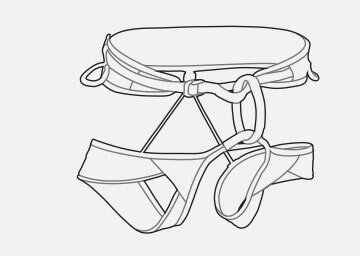
The 3D Vent Lite series harnesses were developed with a focus on low weight, compact pack size and freedom of movement. The design combines lightweight construction with features that support comfort during use and suspension. This is achieved through high-strength HDPE (High-Density Polyethylene) webbing integrated into the waist belt and leg loops. These webbing elements contribute to even load distribution throughout the harness structure. The support material made from monofilament yarns is breathable and supports air circulation and moisture transfer.
-
3D Pad
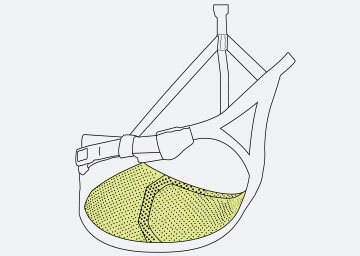
The 3D Pad Technology was developed with a focus on balancing comfort, fit and pack size. The padding is concentrated in areas where loads typically occur during use. The design supports load distribution throughout the harness structure and contributes to overall comfort. Multiple evenly arranged webbing straps support load transfer within the harness system. The ergonomic design, featuring a three-dimensionally shaped waist belt and leg loops, supports body-conforming fit. The reduced padding area contributes to low weight and a compact pack size. The lightweight three-layer foam retains its shape characteristics under load. Open areas promote air circulation and support moisture transfer.
-
Soft Frame Construction
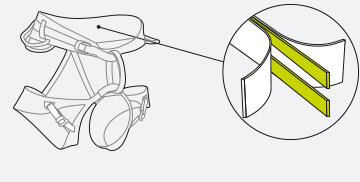
This construction is primarily used in our alpine harnesses, where a balanced combination of comfort, weight and pack size is a key design consideration. Two load-bearing webbing straps distribute the load across the width of the waist belt and support load distribution throughout the harness structure. At the same time, the design promotes air circulation. The distributed load transfer allows for reduced padding. This enables a combination of low weight, a low-profile construction and a compact pack size.
-
Center Fit Construction
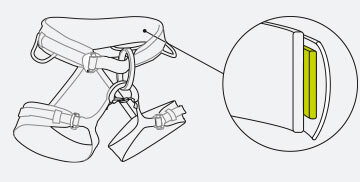
The Center Fit series harnesses were developed as versatile all-round climbing harnesses. In this construction, the load-bearing webbing is complemented by 3D mesh padding. This supports comfort during use. The waist padding can be adjusted along the load-bearing webbing. This keeps the tie-in point centred across different waist sizes while maintaining symmetrical gear loop positioning. Folded edges along the upper section of the waist belt support comfort during use and suspension.
-
Light Frame Construction
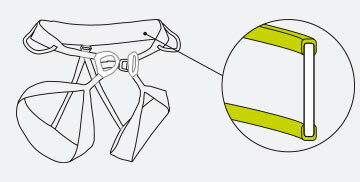
Harness constructions with load-bearing edge webbing are designed for low weight. The continuous edge webbing forms the load-bearing structure around the waist and legs. Loads are distributed between the load-bearing webbing and the padded areas. Combined with a perforated foam mesh material, this results in a lightweight construction with high breathability. This technology is primarily used in our lightweight sport climbing and ski touring harnesses.


Helmet
-
Wing Fit
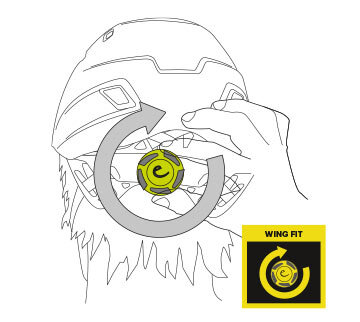
Practical closure system with rear adjustment dial. The webbing cradle can be quickly adjusted to fit all head shapes by turning the dial. During transport the cradle tucks away into the helmet.
-
Neck Strap
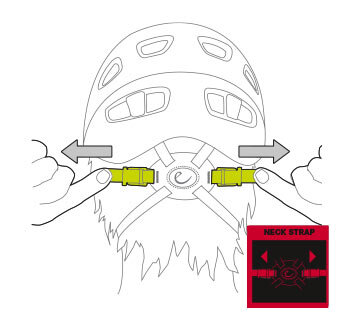
The headband and neck strap can be easily adjusted in both circumference and height using two clip buckles. The design supports individual adjustment, a compact pack size and effective ventilation. For transport, the system can be folded into the helmet.
-
Curv®
Curv® is a thermoplastic composite material that combines the characteristics of thermoplastics with the properties of fibre-reinforced materials. Components made from Curv® feature high stiffness, tensile strength and impact resistance while maintaining a low weight. In addition, the material can be thermoplastically formed. These material properties are utilised in our helmet shell to achieve a lightweight construction with the corresponding protective characteristics.


Lines in motion
-
Coating

A coating helps protect the textile fibres of the line from mechanical wear. The coating influences the handling characteristics of the line and can support its performance properties under specific application conditions. Abrasion behaviour and stiffness can be tailored to the respective requirements. Where required, the treatment is supplemented with UV-protection components.
-
Spliceact
The SPLICEACT product attribute identifies lines whose construction is designed to support good splicing characteristics. This is achieved through the coordination of the yarns used with the respective construction parameters of the line.
-
Stretchact

STRETCHACT indicates lines that have been stretched to make them stronger and reduce their elongation. The natural properties of the fibers are also anticipated so as to guarantee products with permanent length stability.
-
Shrinkact
SHRINKACT indicates the use of a shrinking process that gives the lines far higher elongation than the raw yarn. The process also homogenizes the elongation values.
-
Thermo Shield
Thermo Shield refers to a thermal finishing process in which the shrinkage characteristics of the yarns used are harmonised. This results in a uniform rope construction with defined handling characteristics. The heat treatment contributes to the dimensional stability of the rope construction and supports supple handling over its service life.
-
Protact
PROTACT identifies lines whose construction is designed to provide a high level of resistance to mechanical wear. The sheath construction supports the line's abrasion and wear resistance. These characteristics can contribute to the durability of the line under demanding application conditions.


